What it shows
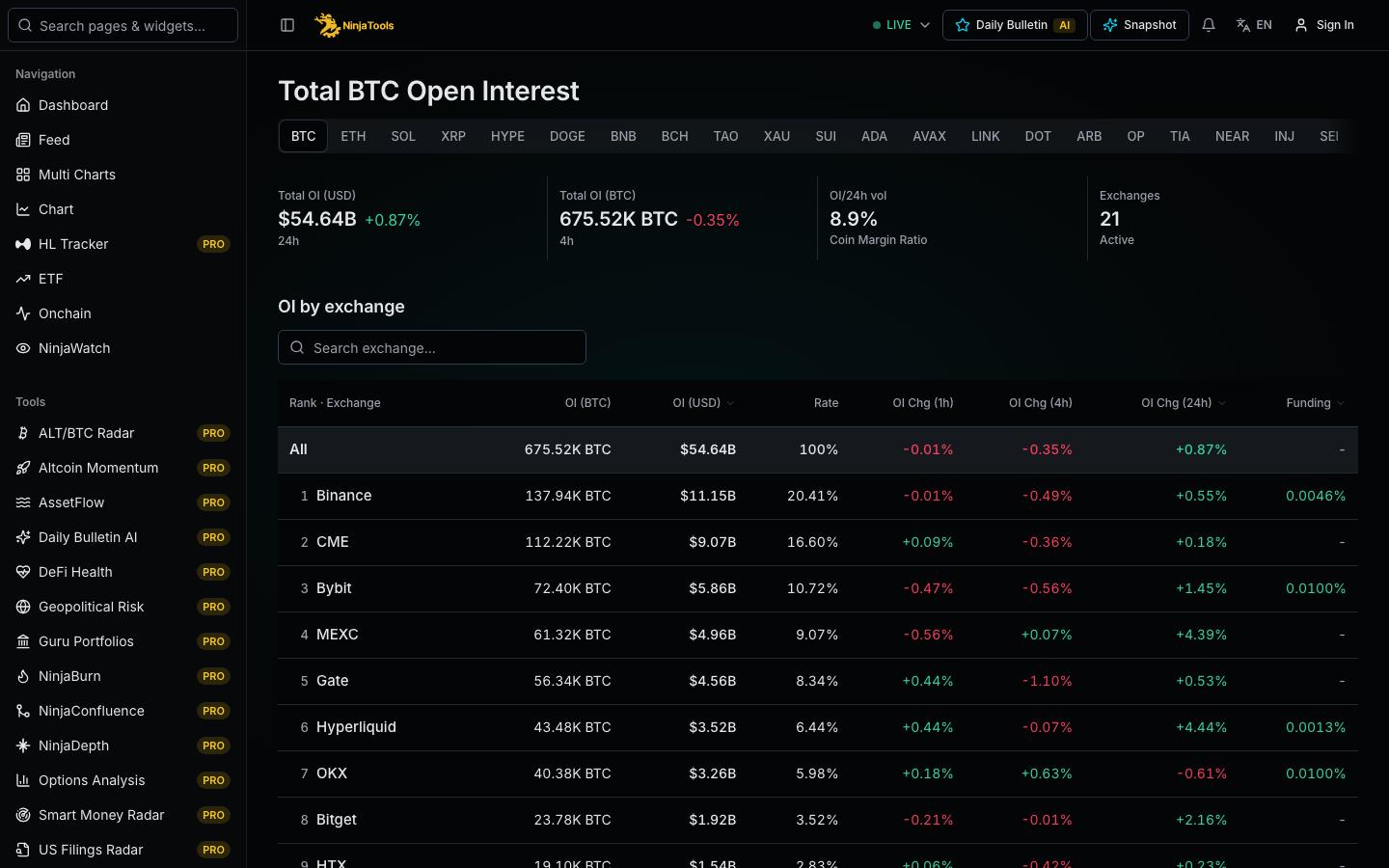
Open interest is the total value of futures and perpetual contracts that are still open. It counts positions, not trades. When a trader opens a new position, open interest rises. When a position closes, it falls. The page shows open interest for a chosen coin, starting with BTC and ETH, in US dollars and in coin units. A table splits the total by exchange and shows changes over one hour, four hours and 24 hours. It also shows the share of open interest that is margined in the coin and not in a stablecoin. The current funding rate of each exchange is in the same table.
- Total OI, USD and coin
- OI by exchange
- 1h, 4h and 24h changes
- Coin-margin ratio
How to read it
Start with the total in dollars and the 24-hour change. Then check the coin-unit total. If dollar open interest rises while the coin total is flat, price alone explains it. If the coin total rises, traders added contracts. Next, read the exchange table. The share column shows how concentrated the market is. Compare the one-hour, four-hour and 24-hour changes to see whether a change is recent or older. The coin-margin ratio shows how much of the total is margined in the coin, which matters because those positions change in dollar value with price.
- Read total open interest in dollars and in coin units.
- Compare the 1h, 4h and 24h changes in the exchange table.
- Check the coin-margin ratio and the funding column of each exchange.
What to keep in mind
Open interest does not show direction. It counts long and short contracts equally, because every long has a short on the other side. A rise means more positions, not more buying. Exchanges define and report it in different ways, and coin-margined contracts are valued at the price of the moment. A fall can mean forced closings or voluntary exits. The table does not show trader identity or leverage. Read open interest with price, funding and liquidation data.
A missing value is not zero. Check the source and time under each data block before you compare numbers.
In the app
Questions
What does rising open interest mean?
It means more contracts are open than before. New positions were opened faster than old ones closed. It does not say whether the new positions are mostly long or short. Read it with price and funding to see whether the market is adding leverage or reducing it.
Is open interest the same as trading volume?
No. Volume counts all contracts traded in a period, including contracts that were opened and closed within it. Open interest counts the contracts that remain open at one point in time. Volume measures activity, and open interest measures outstanding exposure.
What is the coin-margin ratio?
Some contracts use the traded coin as margin, and others use a stablecoin. The ratio shows the share of open interest that is coin-margined. When price falls, coin-margined positions lose margin value too, so their risk profile differs. The page shows the ratio for the whole market of the selected coin.